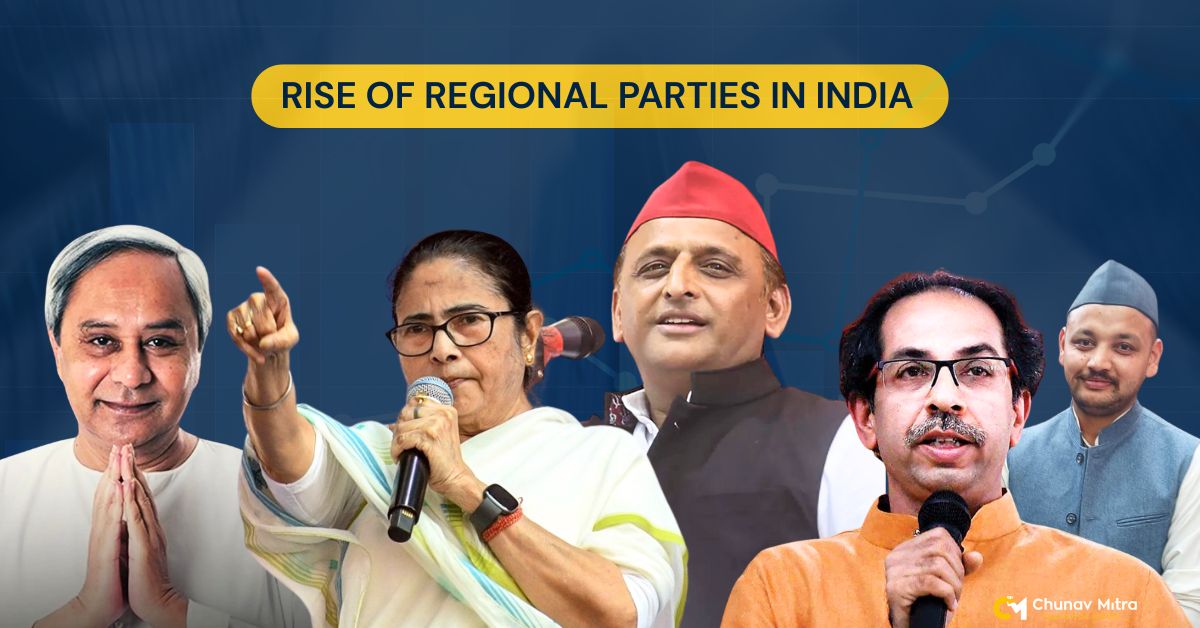
India, the largest democracy country in the world, is well-known for its rich diversity of cultures, languages, traditions, and political beliefs. This diversity has constantly resulted in the rise of not only strong national parties but also strong regional parties as well. Regional parties play a significant role in influencing the creation of governments and policies at both the State and Central levels. To understand the importance of regional parties, let us learn about what is regional parties, what are their significance in Indian Politics, and some of the reasons for the growth of regional political parties in India.
What is Regional Parties?
Before we look into their growth, we must first clarify what regional parties are related to Indian politics. Regional parties are party organizations that operate primarily in one state or region. Their agenda will be local/regional issues that involve regional visions, culture, language, identity, and development. They were more focused on their own state or region where they can have great influence or power, compared to national parties that are competing elections in every state.
A few examples of well-known regional political parties in India include the following:
- Uttarakhand Kranti Dal (UKD) in Uttarakhand
- People’s Party of Punjab
- Biju Janata Dal of Odisha
- Shiv Sena in Maharashtra
- Trinamool Congress (TMC) in West Bengal
- the Nationalist Congress Party
- Samajwadi Party (SP) and Bahujan Samaj Party (BSP) in Uttar Pradesh.
All of these parties are addressed to local/ regional issues and effectively become the voice of the region against the central power.
Historical Background of Regional Political Parties
The rise of regional political parties in India can be traced to the period after independence. Initially, the Indian National Congress seemed to be the leading party across the country. However, as political democracy began to mature, regional aspirations and state-specific matters began to take over. This can be seen from the late 1960’s and into the early 1970’s. Political parties specifically formed on linguistic, cultural, and social grounds began to appear in several states. These parties, over the years, have strengthened themselves and have since become leaders in alliance governments at the national level.
Reasons for the Growth of Regional Political Parties in India
The rise of regional parties has not happened by chance. There are many societal, cultural, and political reasons for the increase in regional political parties. Here are some of the major reasons for the growth of regional political parties in India:
Linguistic and Cultural Variation
India has various languages and cultural traditions. National parties often fail in understanding the linguistic and cultural demands of all the states. Regional parties works successfully because they fit in with regional identities. A good example is the DMK in Tamil Nadu, which emerged from the Dravidian movement and created political space based on pride in Tamil and a claim for cultural independence from the state.
Regional Visions and Local Development
One of the primary reasons for the rise of regional political parties in India is their focus on local development. National political parties do not have the capacity to always deal with regional issues. National parties often ignore issues that are considered to be related to the development of state infrastructure, education opportunities, employment opportunities, and overall welfare issues based on past requirements and the service of their own citizens. Regional Political parties can take over that gap too, claiming or feeling that political discussion can concentrate on primary regional needs.
Identity Politics and Social Justice Movements
Caste, religion and community issues shapes Indian Democracy significantly. Several regional parties are formed with social justice and minority communities in mind. One example is BSP in UP that supports Dalit rights and Samajwadi Party focused on votes from OBC (Other Backward Classes) vote bank.
Limitations of making decisions centrally
Centralised Decision-Making cannot handle state-specific issues. If the people feel that national policies are not addressing local issues, they do rest on their regional leaders as they could require some form of immediate demand that could propose a solution.
Division of Voter Base
As literacy and political awareness grew, people in regions looked for representation that related to and was a reflection of their identity. Thus, the emergence of fragmented voter bases decreased the ability of national parties to control power and resources while at the same time, allowing for the emergence of regional political organizations.
Impacts of Regional Parties on Indian Politics
Regional political parties have gained importance due to numerous reasons relating to its role in government. The influence of regional parties can be observed in several key ways:
Strong Federalism
Regional political parties help to continue to sustain the federal structure of India by maintaining the representation of individual states in Central decision-making. They also want independence for states to ensure each state is a co-equal partner in the federal arrangement while seeking a fair share of federal resources through demands that oppose centralization or marginalization of states. Regional parties help to ensure that the balance of power between the Centre and states is maintained.
Coalition government
In the present environment of coalition politics, regional parties are playing the role of coordinating power at the national level. In scenarios when no single national party achieves an unqualified majority, regional parties are essential partners in creating a government. Regional parties will act as rulers when negotiating for positions in ministries, financial packages exclusive to a regional party’s state of affiliation, or some other concession which favours their home state. Their negotiating leverage helps ensure regional concerns remain relevant to central governance.
Focus on Local Issues
National parties will focus on national issues; they are not able to handle the complexity required to manage locality-specific issues. Regional political parties focus on local-oriented issues like infrastructure, jobs, irrigation, and education to help build momentum where there exist regional disparities in development.
Planning and Forming Policies
In areas such as health care, linguistics, and cultural diversity, regional parties are at the forefront of influencing national policy. They represent the voices that stand for regional language use, the protection of cultural heritage, rights of minorities, and support for inclusive policies at the Centre. With their role in debating in Parliament and committees, regional parties guaranteed that national laws represent the diversity of the Indian population and the interests of the respective states.
Conclusion
The rise of regional parties is a part of the Indian political situation that needs to be considered. Understanding what is regional parties, is essential in analyzing their role in Indian democracy, and the numerous reasons for the rise of regional political parties in India – from cultural diversity and regional aspirations to coalition politics and strong leadership – are well established.
It is easy to see how in a political environment centred around national parties, regional parties are a means to ensure that the many different voices representing the interests of various states and communities cannot simply be ignored. Regional parties represent the strength of Indian democracy, which is the ability to accommodate diversity and still remain unified.