The most powerful component of the Indian democratic system is the electoral process, which gives people a platform to voice their opinions. There have been several reforms over the years aimed at improving the process of elections through inclusion and transparency. One of those reforms was NOTA, which stands for None of the Above. NOTA is a feature that allows a voter to select that they dislike all candidates and reject them. In this article, we will find out what does NOTA means, which year NOTA introduced in India, and relevant questions like what if NOTA wins and what happens if NOTA wins in India.
What Does NOTA Mean?
What does NOTA mean? NOTA means “None of the Above.” NOTA is available on the electronic voting machine (EVM) and on the ballot paper, meaning the voter can express the preference for NOTA and therefore formally express disapproval of all the candidates in the constituency. Until NOTA was introduced, there was no effective way for voters who did not agree with any candidates or who wished to not vote for any candidates, other than to not vote or use the prohibition against an individual voting under “Section 49-O,” a provision in which the voter must inform the election officials that he or she would not like to vote for any candidates. However, the voter’s right to confidentiality was violated because this required completing a form at the polling place.
With NOTA coming into force, voters can now communicate their unhappiness with all candidates, vote all of the candidates out, but still be part of the democratic right to vote. In simple terms, NOTA gives the voters the “right to reject,” thus preserving the right of not voting.
Which Year NOTA Introduced in India?
You may wonder which year NOTA introduced in India. In 2013, the Supreme Court of India ruled that if voters do not find anyone suitable, they should have the right to reject all candidates in secret. As a result, in the 2013 Assembly Elections in state elections like Chhattisgarh, Mizoram, Rajasthan, Delhi and Madhya Pradesh, the Election Commission of India implemented NOTA. Further in the 2014 General Elections, NOTA was applied federally for the first time.
NOTA was a progressive move toward strengthening democracy. It provided eligible voters a way to express their opinions without being forced to not vote at all.
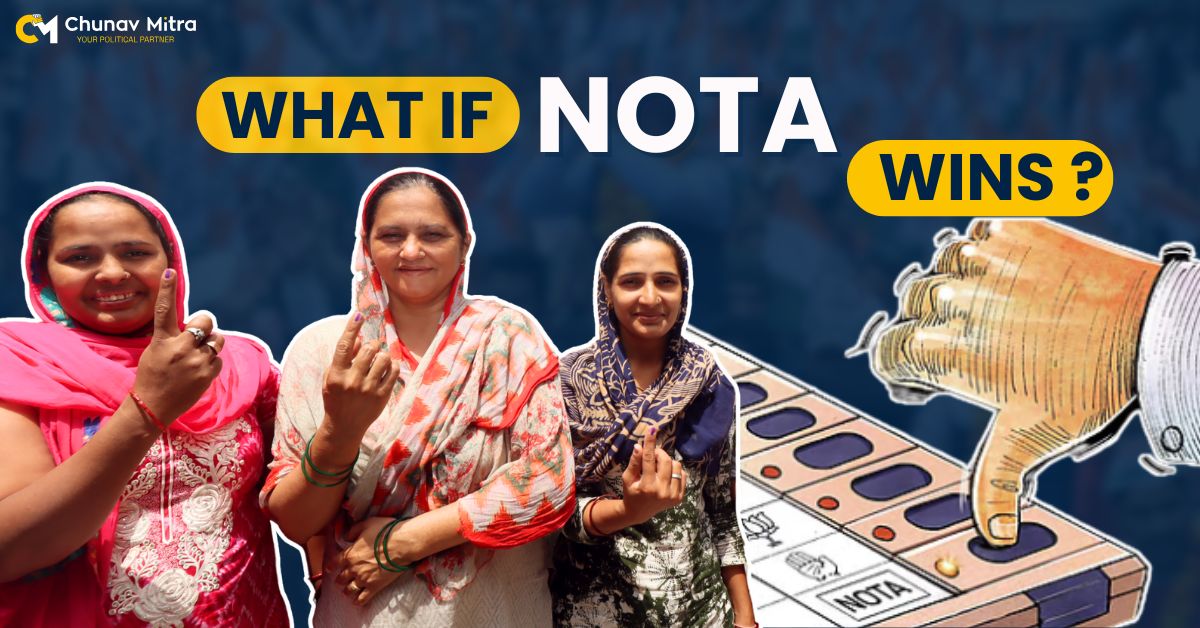
What If NOTA Wins?
This is a common question that we get asked: what if NOTA wins an election? Let’s consider an example: if the maximum votes in a constituency were cast for NOTA. Would that result in a re-election? Would all the candidates be barred from contesting?
In truth, that would not actually be the case. In India, NOTA could secure the highest number of votes, and the election would still remain valid. In that case, the candidate with the second-highest vote (among the contested candidates) would then become the winning candidate.
This is because, in law, NOTA is currently treated as a non-conclusive option upon which the voters can express their dissatisfaction, but NOTA does not directly affect the election outcome in relation to seats.
What Happens If NOTA Wins in India?
Now let’s know what happens if NOTA wins in India. Voters assume that if NOTA wins the highest votes in a constituency, it will have to call for elections again and add new candidates. However, in the current system of elections, the facts are rather different.
No re-election
If NOTA gets the most votes, it does not invalidate the election results. The Election Commission of India has expressed that NOTA is not, in a factual sense a candidate. NOTA is a symbolic exercise that cannot cancel any election or ask for re-elections – Because the election is what the election is, it will only continue despite what percentage of NOTA votes exist.
The candidate with the highest number of valid votes behind NOTA wins
So again, if NOTA receives, say 40% of the vote in a constituency, and Candidate A receives 30% of the vote, Candidate A will still win the election. NOTA is not a “valid candidate”, it is representation that people do not approve of any of the candidates. It is done that way so that one of the candidates is always recorded as winner, irrespective of how many people do not like the choices.
Voter sentiment is recorded
Even though NOTA cannot affect the final result, it has political significance. A significant number of NOTA votes become part of the official election record, and this documentation will function as an indicator of public dissatisfaction. When voters feel in large numbers they must support NOTA, they send a very clear statement that they are not satisfied with the candidates available to them. Political parties have to accept the dissatisfaction of the electorate, affecting their candidate selection process in the future.
A pressure to have better candidates
While NOTA cannot prevent a winning candidate from being declared, it works as an indirect pressure on the election. The media love to highlight constituencies where NOTA is a high percentage, generating some national interest in where frustration among voters is happening. Political parties may feel embarrassed that a large number of votes in their party or candidate availability in their constituency, where they consider that they enjoy to some extent, hits the newspaper, and makes them rethink for the next election cycle about choosing candidates with a positive record, and social connection with the electorate.
Impacts of NOTA in Indian Democracy
Although NOTA may not impact election results directly but it does play a huge role in impacting voter behaviour in the electorate, and it plays a strong signalling role to parties and candidates. Not to mention it is more than just a button on the EVM—it is a measure of public feeling, dissatisfaction, and a demand for better governance.
Encourages Voter Participation
When citizens do not have any candidates they consider worthy of their vote, it can sometimes make them feel detached from the political process. Earlier these people either did not vote or destroyed their ballot, which had very little effect. With NOTA, disengaged voters at least have an option to participate in some way and will not just remain silent. It will ensure an improvement in voter turnout and ensure any dissatisfaction from the electorate is formally documented and structured.
Promotes accountability
When NOTA receives a large number of votes in a candidate’s constituency, it sends a clear message to political parties. A high vote share for NOTA indicates that the electorate are not happy with the candidates they provided. This forces the politician and political parties to re-examine their attitude towards candidates, their selection processes, and their accountability to citizens.
As a symbol of protest
NOTA is often called the silent protest of democracy. Unlike protests in the streets, or saying you won’t vote in a boycott, it gives citizens a means to reject all of the candidates peacefully and in a constitutional way, without destroying the democratic process. It allows voters to express their disagreement officially and ensures that anyone who is dissatisfied with the choices have it shown in the election data.
Response to Democracy
NOTA itself is a reminder that democracy is about leaders chosen but also, importantly, about the freedom to reject unsuitable leaders. NOTA allows citizens to feel empowered, recognized, and more specifically, that their voice matters—even if that voice is a negative vote. Disapproval supports the belief that democracy, choices, and power are held by the people.
Conclusion
The introduction of NOTA has changed the game of Indian democracy. We learnt what does NOTA means, we understood which year NOTA introduced in India, we looked at what if NOTA wins, and we clarified what happens if NOTA wins in India. As much as NOTA works as a symbolic expression today, the increasing trend of reform through NOTA portrays a demand for improved governance and more accountable candidates.
In the end, NOTA is not only a button on an EVM; It reflects the fact that democracy only works when people engage with it, even if it is to disagree with it.